Table of Contents
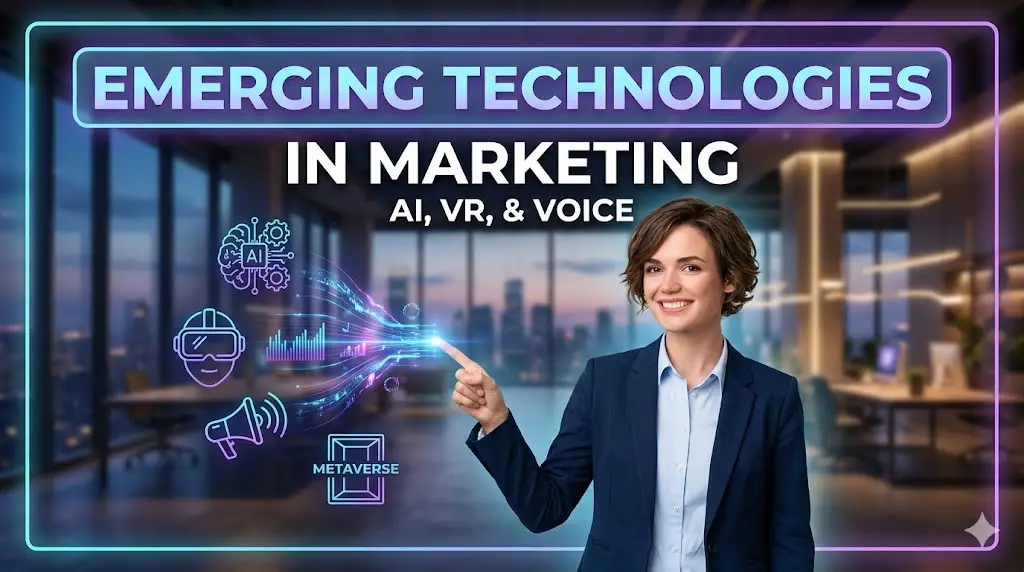
In the traditional marketing playbook, the goal was pretty simple: reach as many people as possible and hope the message stuck. Today, that “spray and pray” method has been replaced by a sophisticated, technology-driven, easy, and accurate method that feels less like a sales pitch and more like a conversation.
We are currently witnessing a digital renaissance in which emerging technologies in marketing are not just changing the tools we use, but the very nature of how brands and humans interact, making it easy to reach any business platform.
From the integration of generative AI to the immersive worlds of the metaverse, the landscape is shifting. For businesses to thrive, understanding these shifts is no longer optional; it becomes mandatory.
How AI and Hyper-Personalization Redefine Emerging Technologies in Marketing?
At the heart of this transformation is AI. While AI has been around for years, its recent evolution into “Generative AI” and “Predictive Analytics” has unlocked a level of creativity and efficiency that was thought impossible previously. Modern marketing is moving toward hyper-personalization.
This goes further than putting a customer’s first name in an email subject line. It involves using machine learning algorithms to analyze vast datasets in real-time, predicting every consumer’s needs before they even articulate them.
Imagine a digital storefront that reorganizes its entire layout based on a visitor’s past behavior, or a streaming service that generates custom trailers for a movie based on the specific genres a user prefers. This level of detail is becoming the gold standard for digital services.
https://amdigitalmarketingagency.com/: Navigating Emerging Technologies in Marketing (The Renaissance of Connection)Brands that use AI to provide customized experiences see significantly higher engagement rates than before because they are solving problems rather than just pushing products.
Moreover, AI-driven chatbots have evolved from clumsy scripts into refined virtual assistants capable of handling complex customer service inquiries, ensuring that the brand is “always on” without losing the human touch in tone and understanding.
The New Boundary of SEO: Search in the Age of Voice and Visuals
For many years, SEO (Search Engine Optimization) was dominated by text-based keywords and backlink counts. However, the rise of smart speakers and visual search tools is rewriting the rules. As search engines become more instinctive, the focus of SEO is shifting from “tricking the algorithm” to providing real, high-utility value to the end-user.
- Voice Search and Semantic Intent: People speak differently than they type. Voice queries are longer, more informal, and usually phrased as complete questions. This requires marketers to shift towards “Long-tail keywords” and natural language processing (NLP). To rank today, content must provide direct answers to these like “Who, What, Where, and How” of a consumer’s life.
- Visual Search Revolution: The ability to snap a photo of a pair of shoes on the street and find exactly where to buy them is a game-changer for e-commerce. Refining images with high-quality metadata and schema markup is now just as important as optimizing a blog post.
- Core Web Vitals: Google’s emphasis on user experience, loading speed, interactivity, and visual stability means that technical SEO is now intricately linked to web design. A beautiful site that is slow to load is, in the eyes of a search engine, a failed site.
Immersive Experiences: AR, VR, and the “Phygital” “Hybrid” Shift
The line between the physical and digital worlds is blurring, giving rise to the “Phygital” or “Hybrid’ retail experience. Augmented Reality (AR) and Virtual Reality (VR) have moved out of the gaming world and into the marketing mainstream, offering utility that consumers actually crave.
As noted in the, AI is now the baseline for infrastructure, not just a differentiator.” Explore the specialized digital marketing services to see how we integrate AI into real-world
Consider the “try before you buy” revolution. Beauty brands now allow customers to virtually apply makeup using their phone cameras, and furniture sellers let users see how a sofa fits in their actual living room through AR overlays.
These technologies reduce the “friction of distance” and the “uncertainty of purchase,” leading to lower return rates and higher customer satisfaction, and improvement of business.
Meanwhile, virtual reality, though still in its formative years, offers a glimpse into a persistent virtual world where brands can host events, sell digital assets (NFTs), and build communities. It’s a space where the brand experience isn’t something you watch; it is something you occupy.
Data Ethics and the Privacy Safe Future
As technology advances, so does the public concern for privacy. We are entering a “cookieless” era where third-party tracking is being phased out by major browsers. This has led to the rise of Zero-Party Data. Zero-party data is information that a customer intentionally and protectively shares with a brand, often in exchange for a better experience.
This shift is humanizing marketing by forcing brands to build trust with their customers. If you want a customer’s data, you must provide enough value and clarity to earn it.
Whether through interactive quizzes, polls, or personalized preference centers, the goal is to create a valuable exchange. This ethical approach to digital services is creating stronger, more adaptable relationships. In this new landscape, privacy is not an obstacle to be cleared; it is a competitive advantage to be welcomed.
The Power of Automation and Programmatic Advertising
Efficiency is the backbone of modern marketing operations. Marketing Automation allows small teams to execute complex, multi-channel campaigns that activate based on specific user actions.
Whether it’s a “welcome” sequence for a new subscriber or a “cart abandonment” reminder, automation ensures that no lead falls through the cracks. It allows marketers to step away from repetitive tasks and focus on a high-level approach and storytelling.
Parallel to this is Programmatic Advertising, which uses AI to buy and sell ad space in a real-time public sale. Instead of buying a blanket ad on a website, programmatic technology allows brands to buy an “audience.”
This tells that your marketing budget is spent showing ads only to the people most likely to be interested in your offer, maximizing ROI and minimizing the “digital noise” that often disappoints consumers.
Blockchain: Openness and Security
Blockchain technology is beginning to solve some of marketing’s old problems, such as a lack of transparency, openness, and ad fraud. By using a dispersed account book, brands can track exactly where their ads are being shown and ensure that the “clicks” they are paying for come from real humans, not bots.
Moreover, blockchain-based loyalty programs allow customers to have more control over their rewards, making them more portable, movable, and valuable.
This transparency builds a layer of responsibility that was previously missing in the complex digital advertising supply chain.
Conclusion: Putting the “Human” Back in Technology
While the list of emerging technologies in marketing continues to grow from 5G-enabled real-time video marketing to neuromarketing awareness, the core objective remains the same: Human Connection.
Technology should not be a barrier between a brand and its audience; it should be a bridge between them. The most successful marketers of the next decade will be those who use AI to be more compassionate, AR to be more helpful, and SEO to be more discoverable.
As we look toward the future, the goal isn’t just to have the smartest algorithms to use that intelligence to create moments of real and authentic delight for the customer. In a world of increasing automation, the most “high-tech” thing a brand can do is to stay “high-touch.”