
Table of Contents
How to boost SEO remains an important question for freelancers or the person owning the business/website. The answer to this question is very simple yet extensive.
Ways to Boost SEO
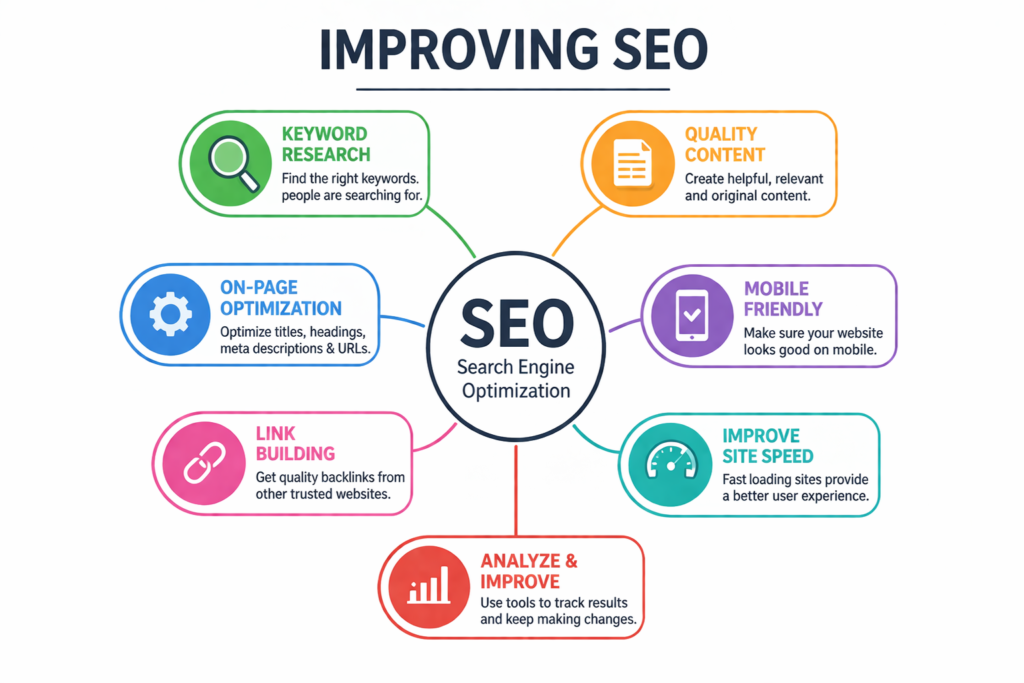
Following are the ways to boost SEO which can be implemented effectively:
- Keyword Research
- On-Page Optimization
- Link Building
- Analyze & Improve
- Improve Site Speed
- Mobile Friendly
- Quality Content
1. Keyword Research
Keyword research helps improve SEO by finding the words and phrases people use when searching online. Start by thinking about your audience and what they might search for, then use tools like Google Keyword Planner or Ubersuggest to discover popular and low-competition keywords. Focus on long, specific phrases (long-tail keywords) and use them naturally in your titles, headings, and content. This helps your website rank higher and attract the right visitors.
2. On-Page Optimization
On-page optimization helps improve SEO by making your website content clear and search-friendly. Start by using your main keyword in important places like the title, headings, URL, and meta description. Write high-quality, useful content that answers users’ questions and includes keywords naturally. Make sure your website is fast, mobile-friendly, and easy to navigate. Also, add internal links between pages and use images with proper alt text. Tools like Google Search Console can help you track performance and fix issues, improving your rankings over time.
3. Link Building
Link building helps boost SEO by getting other websites to link back to your site (called backlinks), which increases your credibility in search engines. Start by creating high-quality, useful content that people naturally want to share. Then, reach out to blogs or websites in your niche and ask for guest posting opportunities where you can include your link. You can also submit your site to directories, share content on social media, and collaborate with others. Another simple method is to find broken links on websites and suggest your content as a replacement. Tools like Ahrefs or SEMrush can help you find backlink opportunities and track your progress.
4. Analyze & Improve
To analyze and improve SEO, you need to track your website’s performance and make changes based on data. Start by using tools like Google Analytics and Google Search Console to check your traffic, rankings, and user behavior. Look at which pages are performing well and which are not. Improve weak pages by updating content, adding better keywords, and fixing technical issues like slow speed or broken links. Also, monitor your competitors and keep optimizing regularly. This helps your website rank higher and grow over time.
5. Improve Site Speed
Improving site speed helps boost SEO by making your website faster and better for users. Start by optimizing images—compress them so they load quickly without losing quality. Use a fast and reliable hosting service, and enable browser caching so returning visitors load your site faster. Minimize unnecessary code (like CSS, JavaScript, and HTML) and remove unused plugins or scripts. You can also use a Content Delivery Network (CDN) to load your site faster worldwide. Tools like Google PageSpeed Insights and GTmetrix can help you test your speed and suggest improvements.
6. Mobile Friendliness
Ensuring mobile-friendliness is important for SEO because most users browse on phones. Start by using a responsive design so your website automatically adjusts to different screen sizes. Keep your layout simple, use readable font sizes, and make buttons easy to tap. Optimize images and reduce heavy elements so pages load quickly on mobile devices. Avoid pop-ups that block content, and make sure navigation is smooth and easy. You can test your site using tools like Google Mobile-Friendly Test and track performance in Google Search Console to fix any issues and improve your rankings.
7. Quality Content
Creating quality content is key to boosting SEO because it attracts users and keeps them engaged. Focus on writing content that is useful, clear, and answers your audience’s questions. Use relevant keywords naturally, but avoid overstuffing. Make your content easy to read by using short paragraphs, headings, and simple language. Add value with examples, tips, or visuals like images and videos. Keep your content updated so it stays relevant. You can use tools like Google Analytics to see what content performs best and improve it over time.
For more information on this topic Contact us