

Why Finding the Right Keywords Feels So Hard?
The best SEO keywords tools show you what people actually type into Google, how often they search it, and how hard it is to rank. Without one, you are guessing. I know, because I guessed for a long time.
When I started writing blogs, I had no budget for paid tools. So I tried every manual strategy and analysis I could find:
- Typing into Google and watching autocomplete. I would type half a phrase and copy every suggestion into a notepad.
- Scrolling to “People also ask” and “People also search for”. I clicked each question to open more questions, then copied them one by one.
- Checking “Related searches” at the bottom of the page. More copying, more pasting.
- Exporting lists into a spreadsheet and trying to guess which ones mattered.
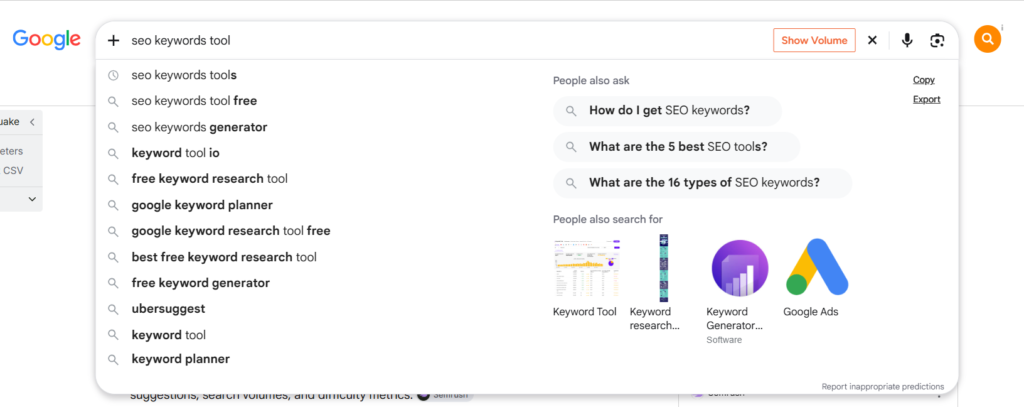
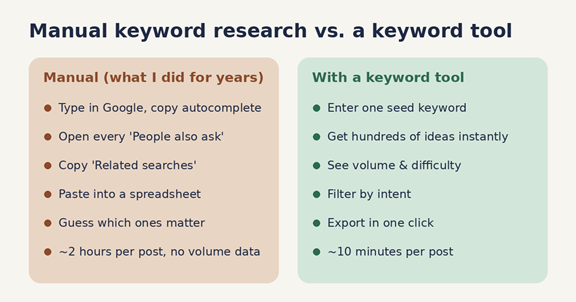
It worked, slowly. One blog post could cost me two hours of research before I wrote a single line. And I still had no idea which keyword had real search volume. That frustration is exactly why I started testing keyword research tools, free and paid, and later built my own.
In this guide, I’ll share what I learned so you can skip the guesswork.
What Is SEO Keywords?
SEO keywords are the words and phrases people type into search engines when they need something. If your page uses the same words and answers the need behind them, Google (and AI answer engines) can match your page to that search.
Keywords come in a few types:
| Type | SEO keywords example | Search intent |
| Short-tail | keyword tool | Broad, unclear, very competitive |
| Long-tail | free keyword research tool for beginners | Specific, easier to rank |
| Question | how to use google keyword planner | Wants a step-by-step answer |
| Commercial | best seo keywords tool | Comparing before choosing |
| Platform | seo keywords tool for youtube | Wants results for one platform |
My rule after years of blogging: start with long-tail and question keywords. They bring fewer visitors, but those visitors actually read, click and convert.
How Does a Tool for Keyword Generation Work?
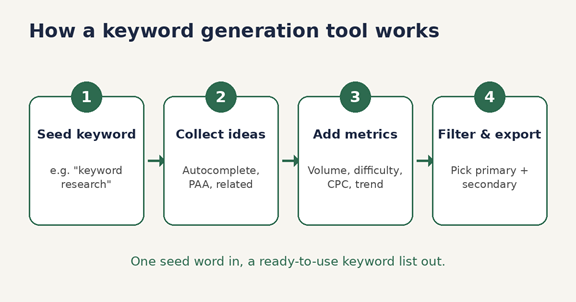
A keyword generator automates the manual work I described above. You give it one seed word, and it returns hundreds of related phrases in seconds. Free or paid, most tools follow the same four steps:
- You enter a seed keyword, for example “keyword research“.
- The tool collects suggestions from sources like Google Autocomplete, “People also ask”, related searches, and its own search database.
- It adds metrics such as monthly search volume, keyword difficulty, CPC and trend.
- You filter and export the list, keeping the keywords that match your topic and your site’s strength.
So, how to work a tool for keyword generation free? Pick a tool that shows at least search volume or a difficulty hint. A long list of words without numbers is just a fancier autocomplete.
Best Free Keyword Research Tools I’ve Tested
There is no single best SEO keywords tool for everyone. Here is how the popular options compare from my own use:
| Tool | Free? | What I liked | What held me back |
| Google Keyword Planner | Free with a Google Ads account | Data straight from Google; great for keyword ideas | Shows volume ranges, not exact numbers, unless you run ads |
| Keyword Tool io | Free plan with limits | Pulls suggestions from Google, YouTube, Amazon and more | Search volume and CPC are locked behind the paid plan |
| Semrush free keyword research tool | Free account, few searches per day | Accurate difficulty and intent data | Daily limits run out fast |
| Google Search (autocomplete, PAA) | Fully free | Shows real questions people ask | Fully manual, no metrics |
| Google Trends | Fully free | Compares interest over time and by country | No search volume numbers |
If you want keyword research tools Google itself provides, Keyword Planner and Trends are the pair to use. For keyword research tools in SEO beyond Google, a free Semrush account is worth having for difficulty checks.
How to Use Google Keyword Planner (Step by Step)
Google Keyword Planner is the most trusted Google keyword research tool free of charge. Here’s the exact process I follow:
- Sign in to Google Ads and switch to Expert Mode. You can skip creating a live campaign.
- Open Tools → Planning → Keyword Planner.
- Choose “Discover new keywords” and enter one to three seed words, or paste a competitor’s URL.
- Set your location and language. For a Pakistani audience, choose Pakistan; for global readers, leave it wider.
- Sort by “Avg. monthly searches” and check the “Competition” column.
- Download the list as CSV and pick 1 primary and 4–6 secondary keywords per article.
Tip from experience: “Competition” in Keyword Planner means ad competition, not SEO difficulty. Always double-check difficulty in a second tool before you commit to a keyword.
SEO Keywords Tools for YouTube
YouTube is the second-largest search engine, and its searches differ from Google’s. People search “how to”, “tutorial” and “review” far more there. A good SEO keywords tool for YouTube pulls suggestions from YouTube’s own autocomplete, not Google’s.
What works for me:
- Type your topic into the YouTube search bar and note every suggestion.
- Use Keyword Tool io’s YouTube tab for a bigger list.
- Put the main keyword in the video title, the first two lines of the description, and the spoken script.
I Built a Free SEO Keyword Generator (Try It)
After years of copying autocomplete suggestions by hand and hitting daily limits on paid tools, I decided to build what I needed. Your Free Keyword Tool is a free SEO tool generator: completely free, no sign-up, no daily cap.
Here’s what it does:
- Generates long-tail and question keywords from one seed word.
- Groups keywords by intent, so you know which are for blog posts and which are for product pages.
- Lets you copy or export the whole list in one click.
I use it myself before every article, including this one. If you’ve been looking for a free keyword generator that skips the manual grind, give it a try and tell me what you’d improve.
Frequently Asked Questions
What is the best free keyword research tool? Google Keyword Planner is the best free keyword research tool for search volume data. Pair it with a free Semrush account for keyword difficulty.
Is Google Keyword Planner really free? Yes. You need a Google Ads account, but you don’t have to run or pay for ads. Without active ads, it shows volume in ranges.
Is Keyword Tool io free? It has a free plan that gives keyword suggestions. Search volume, CPC and competition data need a paid plan.
How many keywords should one blog post target? One primary keyword and 4–6 closely related secondary keywords. More than that usually makes the article lose focus.
Can I do keyword research without any tool? Yes, using Google autocomplete, “People also ask” and related searches. It is slower and gives no volume data, which is why a tool saves time.
Keyword research doesn’t need to be expensive or slow. Start with Google’s free tools, check difficulty in Semrush, and use a free keyword generator to fill in long-tail ideas. Most importantly, write for the person behind the search. Tools find the words; your content has to answer the question.